
Why I want to learn how to use the Soroban (Abacus)
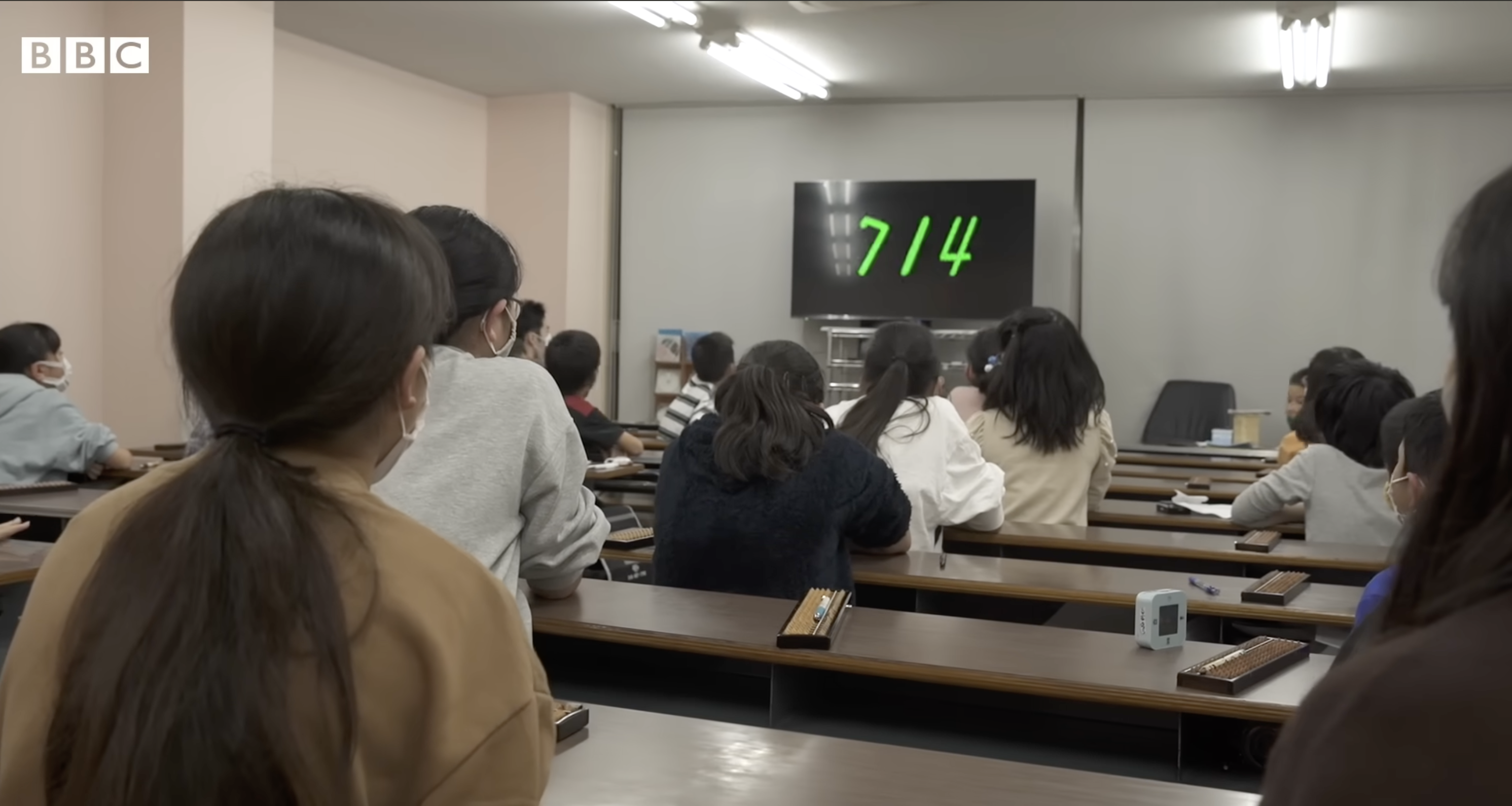
Watch clip on YouTube
https://youtube.com/clip/Ugkxq9rcfuqmeZRnn5O35DFUNpFasCitjyZ4?si=pPqI52lWluzzli55
A couple of years ago I stumbled on this documentary about the Japanese soroban — the abacus. I am sharing a clip from the doc above. You should watch the whole thing if you have the chance. In this segment, fifteen three-digit numbers flash on screen in 1.5 seconds!
I can't vocalize or keep these numbers in working memory. Let alone perform addition and carry digits for these in my head!
The Limits of How We Normally Think About Numbers
Most of us do mental math by talking to ourselves. We hold numbers in our heads as words or symbols — "four thousand three hundred and twenty-seven" — and then try to manipulate them using the same inner monologue we use for everything else. It works fine for small numbers, but several numbers of three or more digits? We run out of working memory real fast.
We lose digits, we second-guess ourselves, and the whole thing collapses.
These kids aren't doing any of that. They aren't reciting numbers to themselves. They're seeing them. Years of training on the physical soroban gives them a mental image of the bead positions so vivid they can manipulate it at speed — adding columns and carrying values the way you or I might rearrange furniture in a room we know well. Their math moves from the verbal centers of the brain into the visual-spatial ones.
Neuroscience backs this up. Brain imaging shows trained abacus users activate a completely different network when calculating — visual cortex and spatial processing regions instead of the language areas that light up for the rest of us. Verbal distractions don't throw them off. They're not using words anymore. They're using pictures.
Here's the irony. The biggest AI labs in the world are wrestling with the exact same problem — from the other side. Transformers are fundamentally language-based. They process everything as sequences of tokens — words and symbols — predicting the next one in the chain. Great at text. But genuine spatial reasoning? Visual puzzles, abstract pattern recognition, understanding how objects relate in 2D space? They fall apart. The ARC-AGI benchmark tests the kind of flexible visual reasoning that comes naturally to a five-year-old. The most powerful language models score close to zero on it!
This is why researchers like Yann LeCun at Meta argue language models are a dead end for true intelligence. His alternative — world models built on spatial and visual understanding rather than word prediction — is basically what those soroban kids figured out centuries ago: if you want to reason about the structure of reality, stop thinking in words and start thinking in space. The AI community is just now catching up.
More Than a Math Trick
The abacus isn't just a faster way to add numbers. It's a different way of engaging with thinking itself.
We live in an age of cognitive offloading. GPS remembers how to get home. Our phones remember birthdays. AI drafts our emails, summarizes our reading, even forms our opinions. Each tradeoff feels small. But they accumulate. Research suggests that when we consistently skip the mental effort, the neural pathways that support reasoning, memory, and independent judgment start to weaken.
I am going to dig deeper into this in a future post — what it means to be a liber, a free person, in the classical sense, and why the ancient liberal arts were designed specifically to prevent the kind of intellectual dependency we're sleepwalking into. But the short version: the abacus is the opposite of offloading. It demands you do the work. You move the beads. You build the mental image. You hold the focus. Nothing and nobody can do it for you.
That turns out to be exactly what your brain needs.
The Education We're Missing
Look at how people used to be educated — not the factory-model schooling most of us grew up with, but the older traditions. Roman elites taught their children oratory and law alongside horseback riding and swimming. Japanese samurai trained in both swordsmanship and poetry under the principle of bunbu ichi — the pen and sword as one. The goal was always the same: produce a complete person. Someone who can think for themselves, reason under pressure, and not be easily manipulated.
Our modern school system traces back to early 19th-century Prussia. The explicit goal? Obedient citizens and reliable workers. That model spread across the Western world. It brought universal literacy, but traded away something vital — the cultivation of independent, flexible minds.
The abacus fits into that older, richer tradition. In the classical seven liberal arts, arithmetic wasn't about getting the right answer on a test. It was one of the four arts of the Quadrivium — number, space, harmony, and motion — considered essential to understanding the structure of reality itself. The abacus was how you engaged with number directly. Not a symbol on a page but something you could feel and see and manipulate.
Why This Matters Now
AI can now do most of the cognitive tasks we used to consider hallmarks of an educated person — analysis, synthesis, writing, creative work. If education stays focused on narrow technical skills, those skills get automated before students finish their degrees.
But there are things AI cannot do for you. It can't build your working memory. It can't train your capacity for sustained attention. It can't give you the confidence that comes from solving a hard problem through your own effort. These are the skills that make someone genuinely free — free to use AI as a tool without becoming dependent on it, free to evaluate its output with a critical eye, free to think when the machines are unavailable or wrong.
That's why I'm learning the soroban. Not because I need a faster way to add groceries. Because in a world that's increasingly designed to think for me, I want to make sure I still can.
Note: I created a game to start learning the abacus that I can share with my nephews, but it is fun for adults too!
https://www.victorjemio.com/games/abacus?mode=game
Next up: What the ancient concept of the "liber" — the free person — can teach us about surviving the age of AI. And why the liberal arts were never really about the arts at all.